Showing posts with label hieronymus bosch. Show all posts

2 August 2009

James Ensor, medieval art and death.

Medieval art is one of my favourite art periods, I just love it.

The whole spectrum of medieval art in Europe was dominated by the Christian ideology. The architecture, the astounding Gothic cathedrals, the sculptures, the tapestries, the manuscripts, the paintings, almost every form of visual display was associated with numerous aspects of cultural behaviour, custom and communication used to illustrate Christian philosophy and dogma.

I am not a Christian and I am not a religious person but I adore medieval art even if it is full of God, Saints, religious symbols, devils, angels, and bizarre creatures – maybe all those things are the reason for my adoration of this period.

I love the colours which the artists use in their paintings, manuscripts, tapestries and the roof carvings. I find irresistible the absence of perspective however I find more irresistible the imagination of the artists who created the most incredible fantastic/ surreal paintings and ideas about the heaven’s, hell’s and the world’s hierarchies.

I am fascinated by the fact that the people of the medieval period could have lived in such intimacy with death. Life was never-ending; death was a mere interruption of the continuum; after which the soul would await the Last Judgment (heaven or the hell).


The Dance of Death by Vincent of Kastav

One of the most interesting images of death in the medieval art besides the Last Judgment is the dance macabre, the Dance of Death. It is a strange fantasy for us, but probably very consistent with the medieval acknowledgement of death and life as a continuum.


The Dance of Death by Vincent of Kasta, fragment and copy
One of the best and astonishing images of the Dance of Death is in . It is a fresco made by Vincent of Kastav around 1474. It is a very strange yet wonderful image full of all classes of men, women, children, and between them skeletons walk in procession. There are ten characters in this dance; each one is accompanied by Death. In-between the skeletons dance the pope, the cardinal, the bishop, the king, the queen, the innkeeper, the child, the maimed, the knight, and finally the merchant, who stands by a table covered with goods. The skeletons are naked and some of them play music; bagpipes, mandolins and wind instruments. The merchant, who is last in joining the dance, tries to bribe Death by pointing at his money. His efforts are futile; Death will never spare a "dancer" in exchange for mere riches.

Now it is time for me to show how James Ensor fits in to medieval art and death.

James Ensor (April 13, 1860 – November 19, 1949), one of the most famous Belgian artists was obsessed with death, grotesque masquerades, and fantastic allegories. In some point in his artistic development he turned towards religious themes as well. He interpreted them as a personal disgust for the inhumanity of the world.

The most famous painting of him is the immense "Christ's Entry into Brussels". In this painting he took on religion, politics, and art by depicting Christ entering contemporary Brussels in a Mardi gras parade. It is a vast carnival crowd in grotesque masks advancing towards the viewer. Nearly lost amid the teeming throng is Christ on his donkey. Although Ensor was an atheist, he identified with Christ as a victim of mockery.


Christ's Entry into Brussels by James Ensor


His other famous painting "Tribulation of Saint Anthony" could be seen as a modern version of the famous painting "The Temptation of St. Anthony" by Hieronymus Bosch. The work features a hooded holy man inundated by Boschian creatures floating in swampy skies -- devils and demons that fart on him and defecate. In my humble opinion this is one of his masterpieces.


Tribulation of Saint Anthony by James Ensor
I think that Ensor owes debts to medieval art, medieval artists and the medieval view of the world. The attitudes and images of the period between 500-1.000 years ago are the origin of many of his paintings.

There is a major Ensor exhibition at the Museum of Modern Art in New York City at the moment. Unfortunately "Christ's Entry into Brussels" isn't included in the Show in MoMA. But I saw it once in the J. Paul Getty Museum in Los Angeles.

The exhibition will travel to the Musée d'Orsay, Paris, October 2009–February 2010.

20 February 2008

New surrealist painting - Bizarre Dream

I just finished my new surrealist painting. Tell me what do you think about it? Feed back is actually not really a good thing for an artist. I have to admit I don't like criticism, I hate it. Negative critique has always discouraged me. Probably it is normal, especially if you are an artist; we have big egos but also very often we are very uncertain about our creations.

Here is the painting - "Bizarre Dream" or should it be Bizz Dream"?

9 January 2008

Where to find the best-known works by Hieronymus Bosch

When I was a little girl I promised myself that I would see all the most important museums in the world. (I still have the evidence of it, in my diary) I am 51 as I am writing this and I have to say that I have almost completed my desire! However, there still are a few that I wish to visit. Some of the museums I have visited several times and I will do it again and again. Do I love museums, yes I do. I love to see the original paintings, no copy can compete with the original. I love to see the museum's buildings too; I love to smell the explicit atmosphere of specific museums. They are so diverse, so unique.

But this is not what I wanted to tell you. I want to give you some information about Hieronymus Bosch's works, and where to find them.

The first painting, his best known work "The Garden of Earthly Delights", is to be found in the Prado in Madrid. Museo del Prado is one of my favourite museums, and not only because of the great collection of Hieronymus Bosch, but also because of the great collection of Spanish art of course.

What can you find more from Bosch (fantasy work) in Prado:

  • The Seven Deadly Sins and the Four Last Things;
    completed in 1485.
  • Paradise and Hell; painted c.1510. The work consists the left and right panels of a minor triptych based on The Haywain Triptych (also in the Prado).

    This painting is part of a series of four, the others are Terrestrial Paradise, Fall of the Damned and Hell.

  • Copy by a follower of Bosch The Temptation of St. Anthony.

The painting The Temptation of St. Anthony currently hangs in the Museu Nacional de Arte Antiga, in Lisbon

The triptych of the Temptation of St. Anthony
is to be found in the Royal Museums of Fine Arts of Belgium in Brussels. One of my favourite museums, too. If you are in Brussels don't forget to visit it. There are some utterly amazing art works hanging on the walls.

The Garden of Earthly Delights is not my favourite work of Bosch though. My preferred painting is without doubt a triptych (from an altar) The Last Judgment created sometime after 1482. This triptych currently resides at the Academie für Bildenden Künste in Vienna. Just saw it again last November spending two weeks with my darling Jim in my darling Vienna.

The other work of Bosch that I really like is the Ascent of the Blessed, painted sometime after 1490. It can be seen in the Palazzo Ducale, in Venice, Italy.


Hell
Hell Bosch, Hieronymus

Giclee Print

Buy at AllPosters.com


6 January 2008

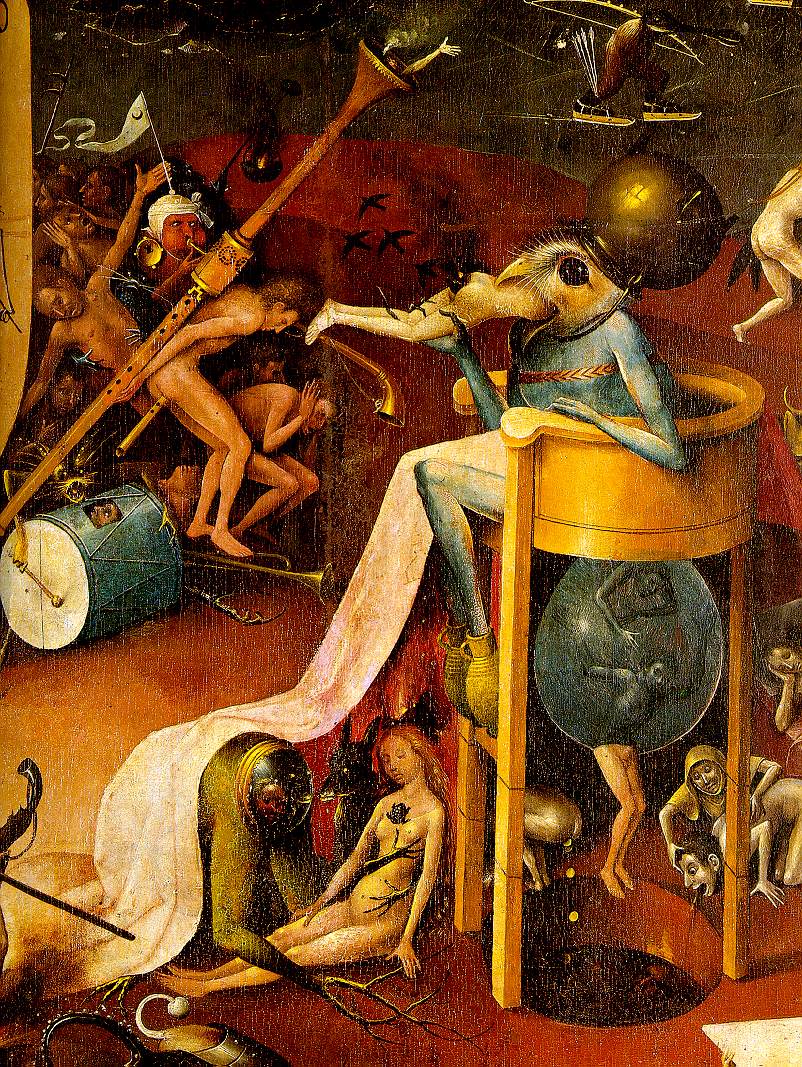
Hieronymus Bosch and his Fantasy Art


In all books about art and all the books about fantasy art Hieronymus Bosch is mentioned as the father of surrealist art and the Fantasy Art genre. All those monsters, impossible structures of the machines and the bizarre landscapes he painted in his works, are a great example of Fantasy Art. His style was unique, strikingly free, and his symbolism, unforgettably vivid, remains unparalleled to this day.

Indeed Bosch had a tremendous fantasy or maybe even a tremendous fear of hell. Hieronymus took his work very seriously and absolutely not as an amusement. Marvellous and terrifying, he expressed an intense pessimism and reflected the anxieties of his time, one of great social and political upheaval.


It was his image of hell, his tragic view of human existence, dwelling upon the triumph of sin that forced him to paint all the horror. He was a very religious person and believed in hell, devils, monsters, life after death and all the other things that were ordinary and standard for the inhabitant of Catholic Europe in the XV and early XVI century.

He didn’t want to entertain people, he wanted to frighten them with his bizarre fantasy. I think the man himself must have been very morbid to have been so concerned with pain.

In 1488 he joined the highly respected Brotherhood of Our Lady, an arch-conservative religious group of some 40 influential citizens of 's-Hertogenbosch and some 7000 'outer-members' from all over Europe. Bosch lived at a time when the medieval period was giving way to a new age. His paintings undoubtedly reflect his concern for a changing world. Looked at in this way Bosch and his fantasies are curiously up to date.